

Catalog ads look simple from the outside. You upload a product feed. You connect it to an ad platform. Products start showing. But that is just the starting point.
As inventories grow and channels multiply, things get complicated quickly. Different image ratios. Different feed requirements. Different performance patterns by category. Some products convert. Others burn the budget. Creative fatigue creeps in faster than expected.
Cropink helped many brands automate pieces of this workflow. For smaller catalogs or early-stage teams, that can be enough. But once you start running serious volume across search and social, you begin to notice what is missing.
- More variation.
- Better testing structure.
- Stronger feed control.
- Clearer performance feedback.
That is usually when teams start looking at Cropink alternatives. Below are five options worth considering in 2026 if your goal is not just to publish catalog ads, but to scale them with intention.

What scaling catalog ads actually means
Scaling does not mean turning on more budget.
It means your system can handle:
- Larger inventories
- Frequent price and stock changes
- Multiple ad platforms
- Creative fatigue
- Margin differences across SKUs
If your setup cannot adapt to those variables, you are not really scaling. You are just increasing spending. The right Cropink alternative should help you manage product data cleanly, generate variation, and learn from performance instead of guessing.
1. Marpipe
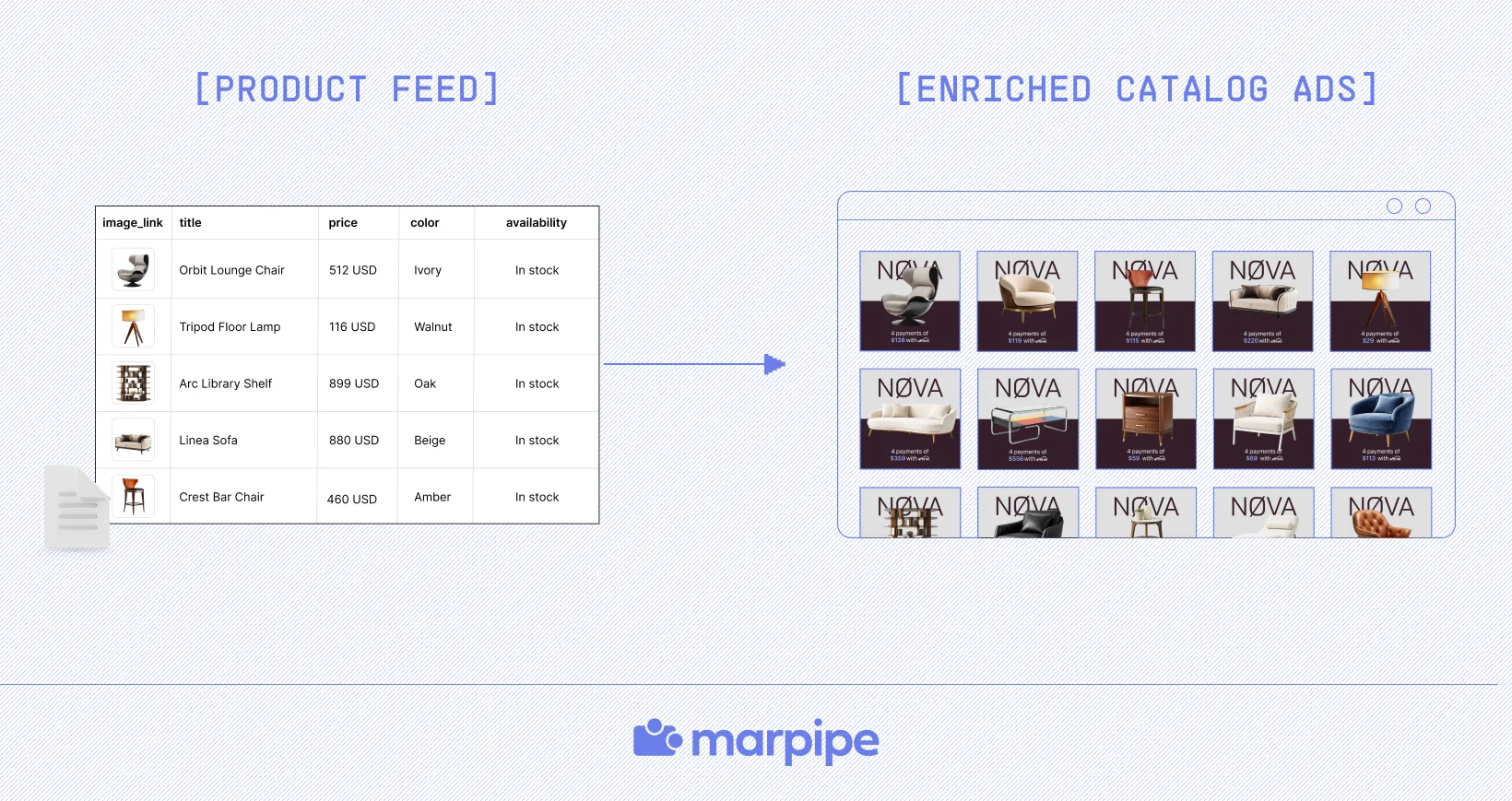
Marpipe approaches catalog advertising differently. Instead of focusing only on feed distribution, it focuses on creative variation and structured testing built on top of your catalog.
Your product feed becomes the raw material. From there, Marpipe lets you generate large sets of creative variations tied to product attributes: different layouts, different copy angles, different visual treatments.
The goal is not to produce one good ad. It is to learn which combinations drive better results.
What makes Marpipe a strong Cropink alternative is that it treats catalog ads as experiments, not just placements. You are not limited to a single template for hundreds of SKUs. You can test visual hierarchy. Messaging emphasis. Promotional callouts. All at scale.
For brands running serious paid media budgets, that testing layer becomes the difference between incremental gains and real performance movement. Marpipe connects directly to your feed infrastructure. It does not replace your data source. It builds on top of it.
If your pain point with Cropink is creative stagnation or lack of structured testing, Marpipe addresses that gap directly.
2. Channable
Channable is often mentioned in conversations about feed management because it gives teams deep control over product data. You can create rule sets that adjust titles, clean up attributes, group products logically, and prepare feeds for different platforms. That flexibility matters when you run ads across Google Shopping, marketplaces, and social channels with slightly different requirements.
Where Channable shines is in data manipulation. If your issue with Cropink is limited feed control or rigid structure, this can be a meaningful upgrade. However, Channable focuses on feed transformation more than creative testing. Many teams use it alongside other creative tools rather than as a full solution. It is a strong option if feed accuracy and rule logic are your main bottlenecks.
3. Productsup
Productsup is built for larger operations. If you are managing international catalogs, multiple currencies, localized attributes, and complex taxonomies, simpler tools can start to feel constrained.
Productsup offers powerful rule engines and the ability to manage complex product data structures across regions and platforms. It requires more setup and usually more technical involvement. But for enterprise brands, that control is often necessary. If Cropink feels limiting because your catalog complexity has outgrown it, Productsup is worth evaluating. Just be prepared for a steeper learning curve.
4. DataFeedWatch
DataFeedWatch sits somewhere between simple feed tools and enterprise systems.
It gives you visual field mapping, rule building, and multi-channel publishing without overwhelming technical overhead. For teams that want cleaner feeds and better optimization across shopping channels, it can be a practical step up from lighter tools.
Where it stops short is creative experimentation. Like many feed-first tools, it ensures your products are eligible and structured correctly, but it does not help you test how those products are presented creatively. If your primary frustration with Cropink is feed quality rather than creative limits, DataFeedWatch may be enough.
5. GoDataFeed
GoDataFeed has been around for a long time in the feed space. It focuses on getting product data from your ecommerce platform to advertising and marketplace destinations reliably. It simplifies channel connections and helps prevent common disapproval issues.
For smaller or mid-sized merchants who need dependable feed publishing without deep customization, it works well. However, similar to others on this list, it is more about distribution than experimentation.
If you need stronger creative insights or testing capabilities, you will likely pair it with something else.
How to decide which Cropink alternative fits
The decision usually comes down to where your friction lives.
- If your biggest issue is feed complexity, tools like Channable or Productsup give you more control.
- If your issue is creative fatigue and plateauing performance, you need something that introduces structured variation.
- If your current workflow requires too much manual editing for each campaign, automation depth becomes the deciding factor.
It is also worth asking a harder question. Are you trying to scale ad volume, or are you trying to scale performance? Publishing more catalog ads is easy, but learning from them is harder.
The alternatives that focus only on feed distribution solve one layer of the problem, the ones that focus on testing solve another problem. The right choice depends on which layer is holding you back.
Catalog ads in 2026 look different
Five years ago, simply running shopping ads was enough to compete.
Today, most brands have clean feeds. Most use automated bidding. Most show similar product tiles. That means differentiation often comes from creative variation and learning speed.
If every competitor is using similar automation, your advantage comes from how fast you test and refine. That is why many brands looking for Cropink alternatives are less concerned with publishing features and more concerned with iteration speed.

Looking for a Cropink Alternative? Marpipe Scales Further
If you are exploring Cropink alternatives, chances are your catalog ads have hit a ceiling. The feed works, the campaigns run, but performance feels flat. At that point, the constraint is usually variation.
Marpipe sits on top of your existing feed and turns product data into structured, testable creative variations at scale. Instead of running one template across hundreds of SKUs, you can test layouts, messaging emphasis, promotional framing, and visual hierarchy systematically.
Catalog advertising in 2026 is less about simply publishing products and more about refining how they are presented. Teams that iterate faster uncover performance gains that static setups miss.
If you want to move beyond feed automation and build a testing engine around your catalog ads, book a demo to see it in action.
FAQs
What are Cropink alternatives used for?
Cropink alternatives are tools that help ecommerce teams manage product feeds, build catalog ads, scale creative variation, and optimize performance across ad platforms.
Do all alternatives support creative testing?
No. Some alternatives focus mainly on feed management or automation. Others, like Marpipe, focus on creative variation and structured testing to improve ad performance.
Can alternatives integrate with multiple ad platforms?
Many alternatives support multiple destinations, from Google Shopping to Meta and TikTok catalogs, but integration depth varies by tool.